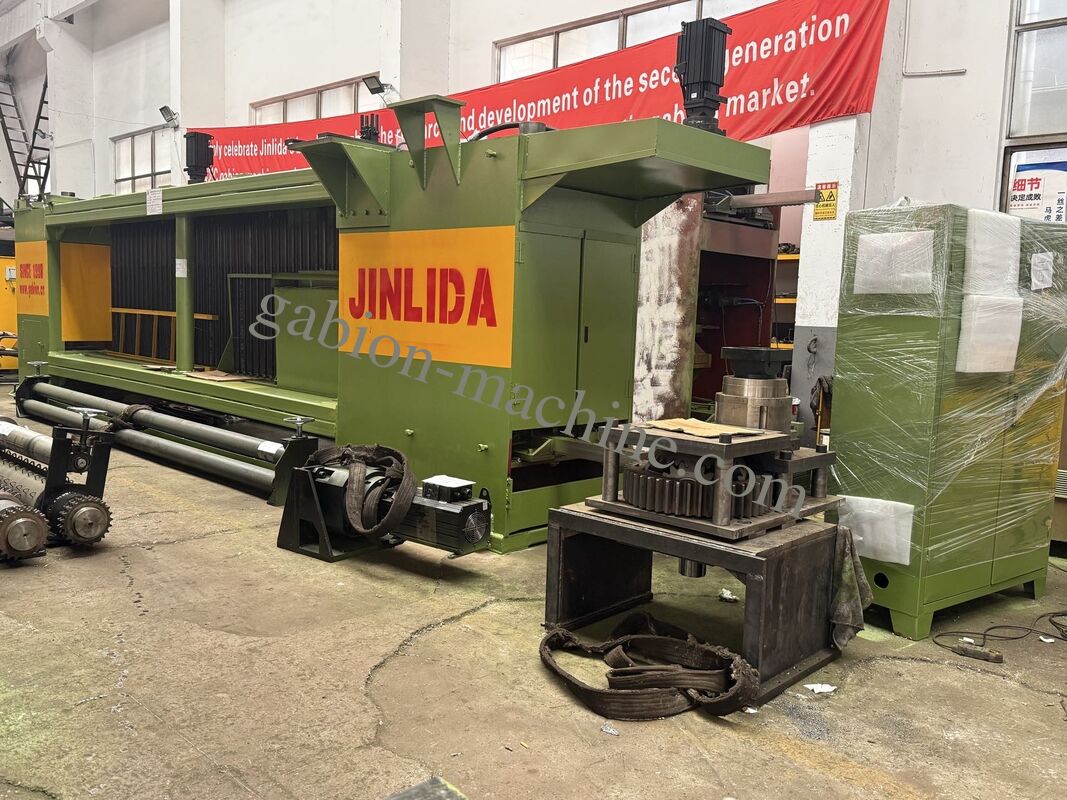
Choosing a gabion mesh machine is not only about production speed. It is about long-term stability, wire compatibility, maintenance cost, and whether the machine can consistently produce qualified mesh over many years.
With nearly 30 years of manufacturing experience, JINLIDA specializes in CNC gabion mesh machines for customers producing gabion baskets, Reno mattresses, retaining wall mesh, riverbank protection systems, and infrastructure materials.
Our machines are designed for galvanized wire, Galfan wire, and PVC-coated wire, helping manufacturers achieve high production efficiency while maintaining stable mesh dimensions and twist quality.
Whether you are building a new factory or upgrading existing production, JINLIDA focuses on providing equipment that performs reliably over years of continuous operation.
Why Production Stability Matters More Than Maximum Speed
Many manufacturers initially compare only the weaving speed of different machines.
However, experienced gabion producers understand that the real production efficiency depends on several factors working together:
Stable wire feeding
Consistent twist formation
Accurate mesh opening
Reduced wire breakage
Lower maintenance frequency
Reliable operation during long production shifts
A machine running slightly slower but continuously without unexpected downtime often delivers higher daily output than a faster machine requiring frequent adjustments.
This is why professional manufacturers evaluate complete production performance rather than speed alone.
Technical Explanation
The quality of gabion mesh depends on the synchronization of every mechanical movement.
JINLIDA CNC Gabion Mesh Machine adopts CNC automatic control technology to coordinate wire feeding, twisting, mesh forming, and winding throughout the production process.
The reinforced frame structure minimizes vibration during high-speed operation, while the optimized transmission system ensures smooth wire movement.
For customers producing PVC-coated gabion mesh, the wire guiding system is specially optimized to reduce unnecessary friction, helping protect the PVC coating during weaving.
Servo-controlled positioning also improves mesh consistency, especially during long production cycles.
These engineering improvements help reduce manual adjustment and improve product consistency.
Real Application
JINLIDA machines are widely used for manufacturing:
Gabion Boxes
Reno Mattresses
River Protection Gabions
Retaining Wall Gabions
Slope Stabilization Systems
Flood Control Projects
Highway Reinforcement
Railway Protection
Coastal Engineering
Customers in Asia, Europe, Africa, South America, and the Middle East use JINLIDA equipment for both government infrastructure projects and commercial construction materials.
Different markets may require different mesh sizes and wire diameters, and our engineering team helps customers select the most suitable machine configuration before production.
Industry Understanding
Every country has different technical standards.
For example:
European projects often require Galfan wire.
Many Asian markets mainly use galvanized wire.
Coastal projects frequently specify PVC-coated wire for additional corrosion resistance.
Highway and river engineering may require different mesh openings depending on local standards.
Selecting the correct machine configuration requires understanding not only the equipment itself but also the application standards of the target market.
This is why JINLIDA works closely with customers before manufacturing begins.
Specifications
Item
Specification
Machine Type
CNC Automatic Gabion Mesh Machine
Working Width
Up to 5300 mm
Mesh Sizes
60×80, 80×100, 100×120, 118×145, 130×152 mm
Wire Diameter
2.0–4.5 mm
Wire Material
Galvanized, Galfan, PVC Coated
Twisting Type
Double Twist / Five Twist
Production Speed
More than 30 mesh holes/min
Control System
CNC Automatic PLC Control
Power Supply
Customized according to local voltage
Operator
1 Person
Where Do These Parameters Come From?
The specifications listed above are based on JINLIDA standard production models tested under factory operating conditions.
Actual production performance may vary depending on:
Wire diameter
Mesh size
Wire material
Coil quality
Operator experience
Local electrical conditions
Before shipment, every machine undergoes factory testing to verify mechanical operation and production performance.
Customers may also request customized configurations according to project requirements.
Why Manufacturers Choose JINLIDA
Instead of simply selling machines, JINLIDA helps customers improve long-term production efficiency.
Our engineering team provides:
Machine selection based on production requirements
Technical consultation before ordering
Factory testing before shipment
Installation guidance
Operator training
Long-term spare parts support
Technical after-sales service
This practical manufacturing experience allows customers to reduce production risks and achieve stable operation after installation.
Frequently Asked Questions
Can the machine produce PVC-coated gabion mesh?
Yes. The wire guiding system is optimized to reduce friction on PVC-coated wire while maintaining stable weaving quality.
Can one machine produce different mesh sizes?
Yes. Different mesh sizes can be produced after changing the corresponding tooling and machine settings.
Is the machine suitable for continuous industrial production?
Yes. The reinforced mechanical structure and CNC automatic control are designed for long production cycles with stable performance.
How do I choose the right machine width?
Machine selection depends on your target product size, factory layout, production capacity, and market demand. Our engineers provide recommendations based on your production requirements.
Why Work with JINLIDA?
For nearly 30 years, JINLIDA has focused exclusively on gabion mesh manufacturing equipment. Rather than offering a one-size-fits-all solution, we work with customers to match machine specifications to their products, wire materials, and market standards. This engineering-first approach helps manufacturers achieve reliable production, consistent mesh quality, and lower operating costs over the long term.